



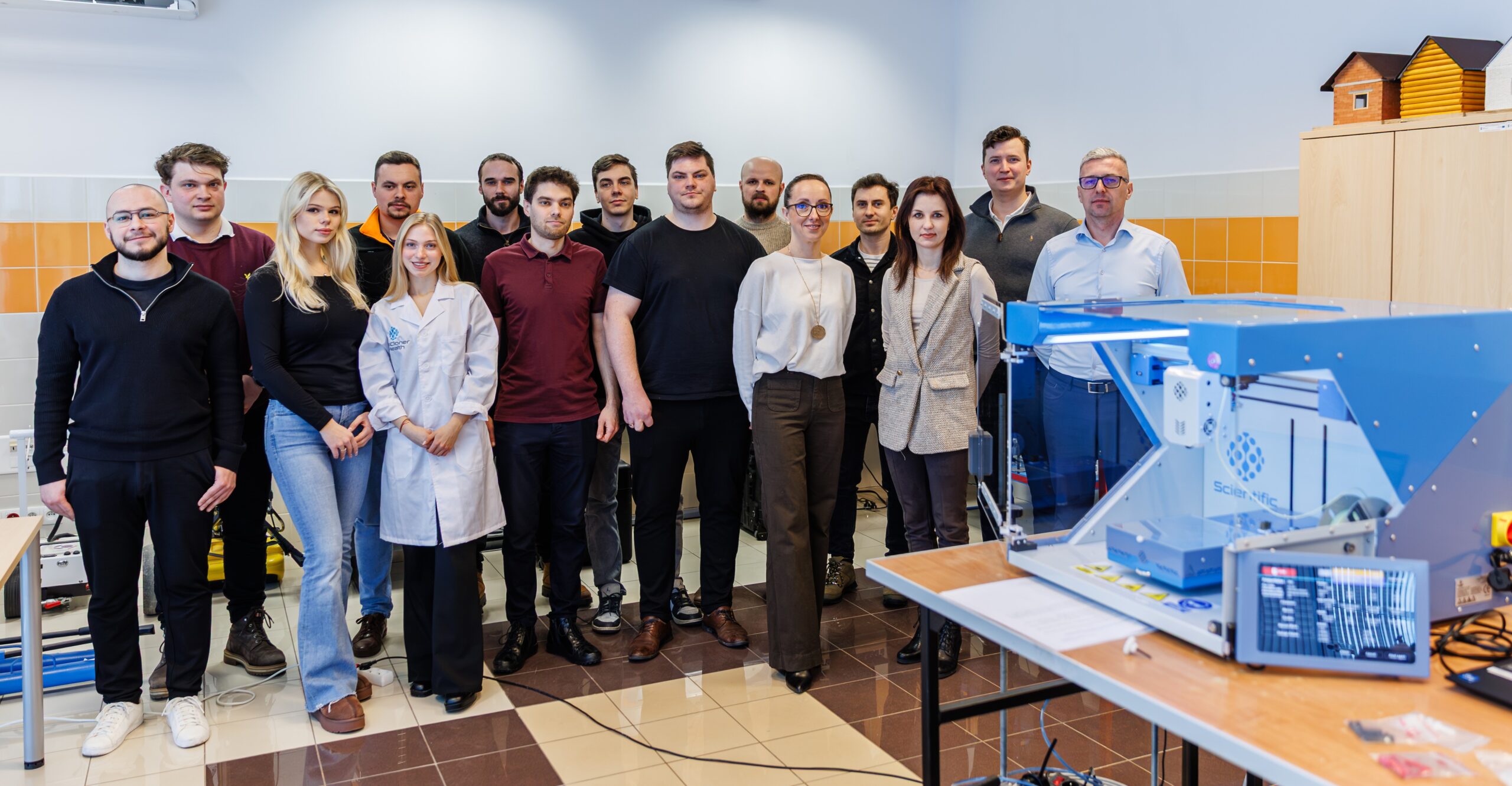
At the headquarters of The State Academy of Applied Sciences in Chełm, a meeting was held with the participation of representatives of BioCloner Health, the Rector, Prof. Beata Fałda, PhD, and the team responsible for the development of the university’s research and teaching infrastructure, including the laboratories of the Engineering Studies Center. The meeting had an operational and strategic character, and its main objective was the implementation of an advanced, multi-head, research-experimental class 3D printer into the university’s technological infrastructure, as well as defining the directions for further scientific and technological cooperation.
Background of the Technology Implementation
The presence of a modern 3D printer at the university in Chełm is the result of cooperation between the industrial sector and the academic community. This initiative emerged as a result of a series of discussions and consultations between representatives of BioCloner Health and the university authorities, whose shared objective was to create a modern research and educational environment aligned with the requirements of Industry 4.0 and 5.0.
As emphasized by Maciej Gołaszewski, a board member of BioCloner Health, the key driver for initiating the collaboration was a shared vision of developing centers that not only teach engineering but also enable its practical application—from the concept and modeling stage to the creation of a functional prototype.
The 3D printer implementation project was not a one-time effort but part of a long-term strategy aimed at developing the region’s technological capabilities and strengthening collaboration between academia and industry.
The Process of Building Technological Infrastructure
The conceptual discussions focused on several key areas:
- creating conditions for conducting research and development in the field of additive technologies,
- developing students’ skills in multi-material prototyping,
- the need to modernize laboratory and technological infrastructure,
- integrating design education with real-world production processes.
The analysis revealed a clear gap between standard filament-based printers used in education and the advanced systems employed in industry and research centers. The response to this need was the implementation of a multi-head 3D printer developed by BioCloner Health, designed for operation in a research and experimental environment.
This decision aligns with the university’s strategic efforts to develop engineering programs, particularly in the areas of:
- materials engineering,
- civil engineering,
- strength of materials,
- electrical engineering,
- chemical engineering.
Technical Specifications of the Device
The implemented 3D printer is a modular system with an open technological architecture. Its most important feature is the ability to use interchangeable print heads, which significantly expands its range of applications compared to traditional FFF systems.
The device allows the use of various technologies, including:
- FFF – printing with thermoplastic filaments,
- DIW (Direct Ink Writing) – printing with pastes, gels, and materials with specific rheological properties,
- printing with high-temperature materials in the form of powders and granules,
- printing with photosensitive (light-curable) materials.
The system supports a wide range of feedstock materials, such as:
- polymer filaments,
- granules,
- functional powders,
- ceramic and composite pastes,
- hydrogels,
- photopolymers.
This design allows multi-material experiments to be conducted within a single technological process without the need to switch devices. This enables, among other things:
- the creation of multi-material structures,
- combining structural and functional materials,
- developing prototypes of hybrid components,
- simulating industrial processes under laboratory conditions.
Significance for the Educational Process
The implemented technology significantly supports the “from concept to prototype” design-based learning model. Students can go through all stages of the engineering process:
- analysis of the technical problem,
- designing in a CAD environment,
- selection of materials and technologies,
- preparation of the production process,
- prototype fabrication,
- conducting functional and durability tests,
- optimizing the design based on test results.
This approach promotes the development of:
- systemic thinking,
- research skills,
- experimental work skills,
- ability to analyze material properties,
- awareness of technological processes.
This technology does not serve merely a demonstrative function; it is a genuine tool for creating innovations. It represents a shift from a reproductive education model to a creative, design-oriented model.
Research and Development Potential
During the visit, the potential applications of the printer in research activities were also discussed, including:
- analysis of the mechanical properties of composite materials,
- development of porous structures,
- research on high-temperature materials,
- testing new formulations of pastes and gels,
- production of functional components for construction and electrical engineering.
The modular design of the device enables interdisciplinary research at the intersection of materials engineering, chemistry, and automation. It provides a foundation for conducting research projects, collaborating with industry, and commercializing scientific results.
Summary
The meeting between BioCloner Health representatives and the university authorities, along with the laboratory visit, confirmed that the implementation of the multi-head 3D printer is part of the university’s long-term development strategy.
The presence of equipment of this class:
- enhances the quality of engineering education,
- enables the conduct of advanced experimental research,
- strengthens collaboration between academia and industry,
- increases the university’s competitiveness,
- inspires students to create innovative solutions.
The implementation of this technology is not merely an investment in equipment, but primarily in the development of skills, intellectual potential, and the capacity to create innovations with regional and national significance.