


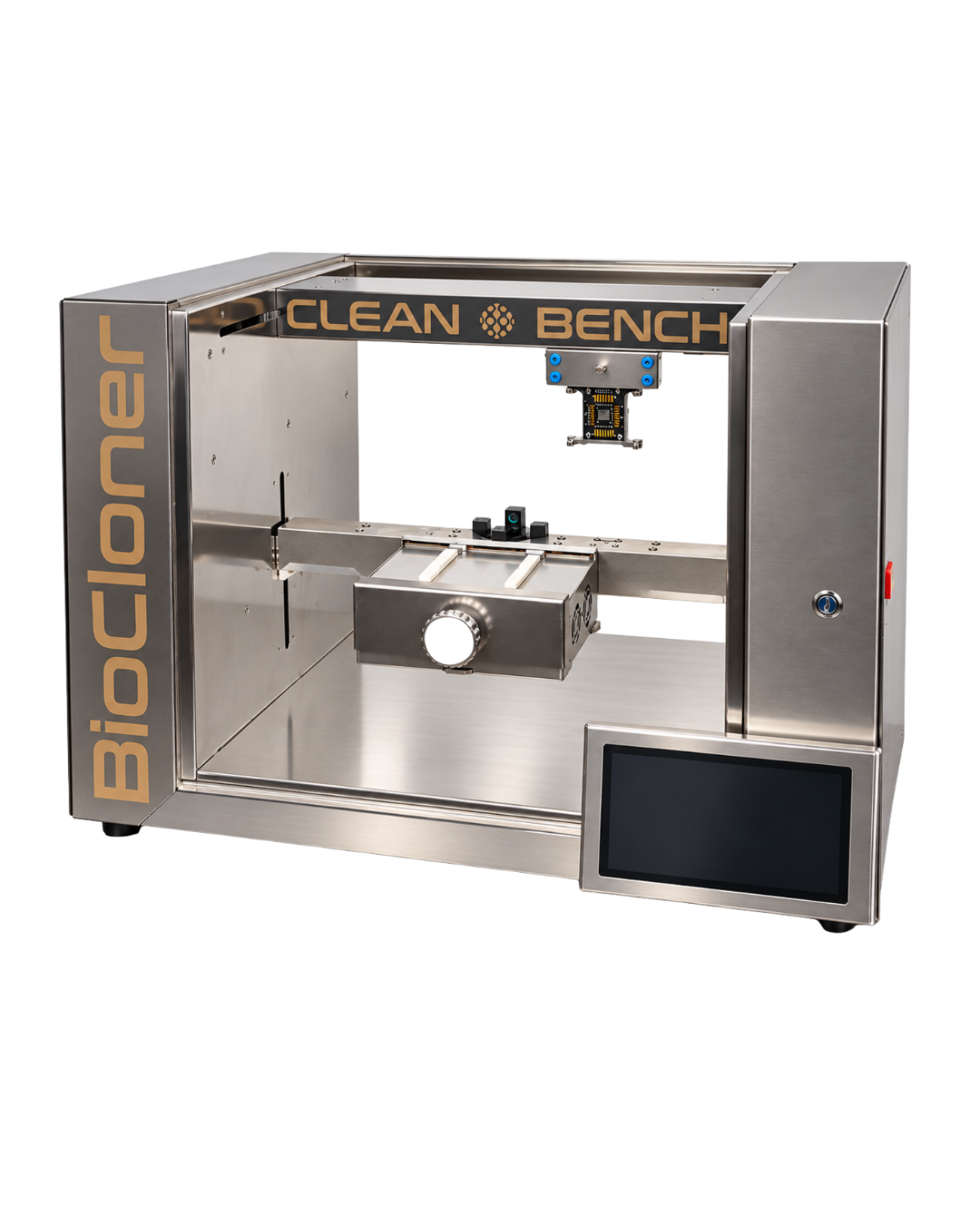
BioCloner CleanBench
Zapytaj o produkt
BioCloner CleanBench is a modular 3D bioprinter designed for advanced research inside laminar flow cabinets. Developed for professional laboratories, universities, research institutes and biotech R&D teams, it combines interchangeable printheads, multi-material bioprinting, laser calibration and precise process control within one configurable platform.
The system supports multiple extrusion technologies and independent temperature and pressure control, allowing researchers to adapt the printing setup to different biomaterials and experimental requirements. A temperature-controlled printbed, dedicated BioCloner software and modular architecture make CleanBench a flexible 3D bioprinting system for research in areas including tissue engineering, biomaterials and regenerative medicine.
O produkcie
BioCloner CleanBench – Modular 3D Bioprinter for Advanced Research
BioCloner CleanBench is a modular 3D bioprinter developed for professional research laboratories and designed specifically for operation inside laminar flow cabinets.
The system combines interchangeable printheads, multi-material bioprinting capabilities, laser calibration, independently controlled temperature and pressure channels, and a temperature-controlled printbed within one configurable research platform.
CleanBench was developed for research teams that need more than a single fixed printing method. Its modular architecture allows the system to be adapted to different extrusion technologies, materials and experimental requirements, making it suitable for advanced 3D bioprinting, biofabrication, biomaterials research and research teams working in areas such as tissue engineering and regenerative medicine.
A 3D bioprinter designed for laminar flow cabinets
CleanBench dimensions, architecture and stainless-steel construction are intended for operation inside laminar flow cabinets while maintaining direct access to the printing area, printheads and key working components.
The construction uses smooth structural elements, concealed cabling and a reduced number of hard-to-access areas, supporting routine cleaning and disinfection of the system.
Modular architecture with interchangeable printheads
The interchangeable printhead system is one of the central elements of BioCloner CleanBench.
Different research projects may require different material delivery methods. CleanBench allows researchers to change the printing configuration by selecting a printhead suited to the required process instead of limiting the system to one extrusion technology.
The available printhead technologies support pressure-based extrusion, mechanically driven extrusion, filament-based 3D printing, granule extrusion and calibration processes.
This modular approach allows one 3D bioprinting system to support a wider range of research strategies while also making it easier to adapt the platform as project requirements change.
Multi-material bioprinting and independent process control
CleanBench supports simultaneous work with up to three materials and provides three independently controlled temperature channels and three independently controlled pressure channels.
This architecture enables researchers to configure different process conditions within the same printing system and supports multi-material bioprinting workflows where individual materials may require different handling parameters.
For tissue engineering, biomaterials development and other areas of biofabrication research, this provides greater flexibility when designing experiments involving different material properties or deposition strategies.
The temperature-controlled printbed provides both heating and cooling, adding another controlled element to the printing process.
Multiple extrusion technologies in one research platform
BioCloner CleanBench supports several material-processing approaches through its interchangeable printhead architecture.
Pressure-based extrusion can be used with selected polymers, bioinks and hydrogels depending on the selected printhead configuration. Mechanically driven extrusion provides controlled material dispensing for hydrogel-based processes.
The FFF printhead extends the system into filament-based processing of thermoplastic materials, while the FGF printhead enables extrusion directly from thermoplastic granules.
A dedicated BLT calibration printhead is used for print surface mapping and supports preparation of the working area before printing.
Together, these technologies create a modular 3D bioprinting platform that can be configured according to the requirements of different research projects rather than being restricted to one material-delivery method.
Laser calibration for repeatable system setup
BioCloner CleanBench integrates a laser calibration system designed to support precise and repeatable positioning.
The system performs calibration across all axes, supports nozzle-tip detection and enables compensation for deformation. These functions help establish a consistent system setup before printing and reduce dependence on manual positioning procedures.
For researchers working with repeatable experimental protocols, reliable calibration provides an important foundation for consistent process preparation.
Temperature and pressure control for material-sensitive processes
Material behavior can change significantly depending on temperature, pressure and extrusion method.
CleanBench provides independent control of multiple process channels so that researchers can adjust printing conditions according to the selected material and printhead configuration.
This becomes particularly relevant when working with bioinks, hydrogels, polymers and other materials that may require specific processing conditions.
Together with the heated and cooled printbed, the system provides a controlled environment for configuring extrusion-based bioprinting processes around the requirements of the experiment.
Dedicated BioCloner software
CleanBench works with dedicated BioCloner software developed to support the printing process from setup to execution.
Researchers can prepare printing protocols, configure process parameters, control the system and monitor machine status through one working environment.
The integrated 9-inch touchscreen also provides direct access to machine control at the device, allowing users to interact with selected settings and monitor the process without relying solely on an external workstation.
Built for research laboratories and R&D teams
BioCloner CleanBench is intended for professional research environments including universities, research institutes, biotechnology laboratories and R&D teams.
Its modular design makes the system particularly relevant for groups working across changing projects and material requirements rather than laboratories performing only one standardized process.
Research teams working in 3D bioprinting, tissue engineering, regenerative medicine, biomaterials development and biofabrication can configure CleanBench around different printing methods while using one integrated platform.
A configurable platform for advanced 3D bioprinting
BioCloner CleanBench brings together modular hardware, interchangeable printheads, multi-material bioprinting, laser calibration, temperature and pressure control, and dedicated software in one professional laboratory system.
Its architecture is designed to give researchers the ability to adapt the equipment to the experiment — instead of adapting every experiment to a fixed machine configuration.
For laboratories looking for a modular 3D bioprinter designed for laminar flow environments and capable of supporting multiple extrusion technologies, CleanBench provides a flexible foundation for advanced research and biofabrication.
Parametry techniczne
Parametr
Wartość
Nazwa producenta
BioCloner Health
Nazwa urządzenia
BioCloner CleanBench
Masa [kg]
55
Wymiary [mm]
743 × 509 × 502
Napięcie znamionowe [V AC]
230
Napięcie sterujące [V DC]
5-24
Moc [W]
690
Prąd znamionowy [A]
3
Zasilanie pneumatyczne [kPa]
10–600
Hałas [dB]
65
Powierzchnia robocza [mm]
150x150x150 (dla ruchu osi Z wartość zależna od głowicy)
Głowice
Wymienne
Typ i podłoża druku
Kompatybilność z różnymi płytkami i naczyniami laboratoryjnymi
Niebezpieczeństwo użytkownika
UV-A radiation, hot surfaces, moving parts
